
Chromadek vs Dibond vs Correx vs ABS vs Foam Board: Which Signage Material Do You Need?
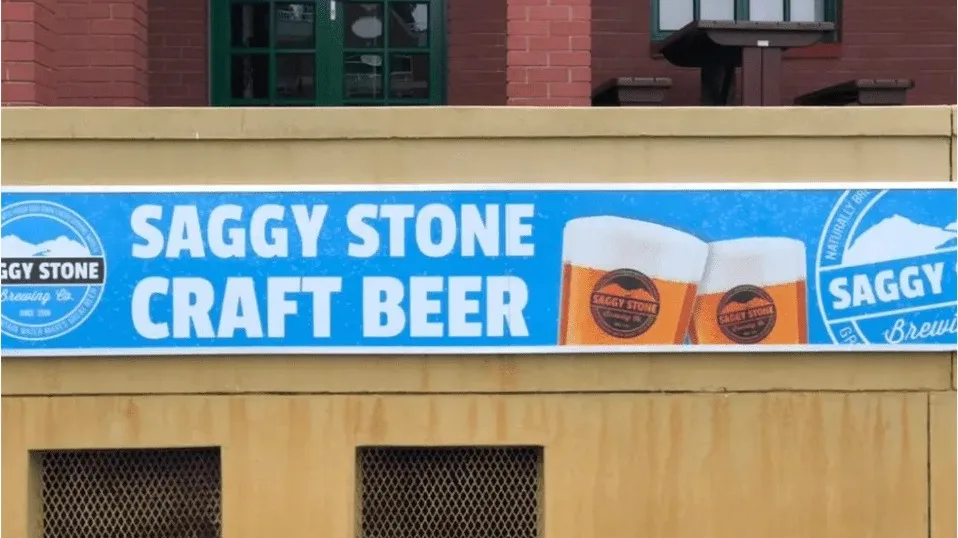
Choose the wrong sign board and Cape Town's weather will find it out within a season: faded colour on a north-facing wall, a panel that bows in the south-easter, a "temporary" board that was asked to be permanent. Choose the right one and the sign simply does its job for as long as you need it to.
This guide compares the five rigid boards we print in-house at our Cape Town factory, Chromadek, Dibond, Correx, ABS and foam board, in plain language, so you can shortlist a material before you request a quote.
For signs that must last outdoors, choose Chromadek (coated steel) or Dibond (aluminium composite): Chromadek is the mid-priced South African standard, Dibond the premium board. Correx is the workhorse for temporary and high-volume outdoor campaigns. ABS is the board for safety, factory and industrial signs that take a knock. Foam board stays indoors, where its smooth matte face suits retail and exhibition displays. All five are UV printed directly onto the board on our flatbed presses.
Quick decision table
Cost bands are relative, from the most economical board to the most premium, not prices. Send us the size, quantity and location for a formal estimate.
| Material | Where it works | Best for | Cost band |
|---|---|---|---|
| Correx (3 mm or 5 mm) | Outdoors, short to medium term; indoors | Estate boards, events, site perimeters, high-volume campaigns | Most economical |
| Foam board (3 mm or 5 mm) | Indoors only | Retail point of sale, exhibitions, hanging graphics, presentation boards | Economical |
| ABS (0.9, 1.5 or 3 mm) | Indoors and outdoors | Safety and compliance signs, factory and warehouse boards, industrial tags | Mid-range |
| Chromadek (coated steel) | Outdoors and indoors, permanent | Shopfront signs, site and development boards, factory and directional signage, framed freestanding signs | Mid-range (flat sheet); frame extra |
| Dibond (aluminium composite) | Outdoors and indoors, long term | Building plaques, shopfront panels, estate maps, roadside site boards | Premium |
Still unsure after the table? Tell us whether the sign goes indoors or outdoors, how big it is and how long it has to last, and we will specify the board for you. Request a quote.
Chromadek signs: the outdoor metal standard
Chromadek is a pre-coated steel sheet, and it has long been the standard for durable signage in South Africa. When a sign has to stay up for years rather than weeks, metal is usually the honest answer, and a flat Chromadek sheet costs less than most people expect for a permanent metal sign. It is the welded frame, not the steel, that adds to the price.
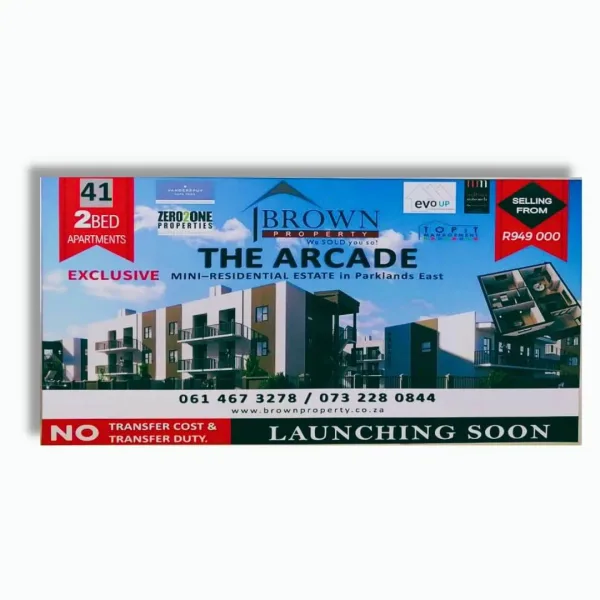
- Material: pre-coated steel sheet, UV printed direct
- Sizes: flat sheets 200 to 1,200 mm high and 200 to 2,400 mm wide; framed signs to custom sizes
- Where: outdoors and indoors, permanent
- Lead time: typically five to seven days
We UV print your artwork directly onto the Chromadek in high resolution and supply it either as a flat sheet, ready to fix to a wall, gate, palisade fence or an existing frame, or as a framed sign on a welded steel frame with a painted finish. Framed signs are made to custom sizes, including large site and development boards.
Typical Chromadek jobs: shopfront signs, site and development boards, estate agent boards, factory and safety signage and directional signs. We can also apply cut vinyl graphics onto Chromadek and quote for installation. Allow a little more time than you would for a Correx run: a Chromadek sign typically takes five to seven days to produce, and a very large or framed sign may carry an additional delivery charge.
Flat sheet or framed sign?
Choose a flat sheet when there is already something solid to fix to: a wall, a gate, a fence or a frame you own. Choose a framed sign when the sign must stand on its own, sit at a roadside or development entrance, or stay perfectly flat at a large size. A frame keeps a big sheet rigid and gives your installer something to bolt to posts or brackets. Tell us how and where the sign will be mounted when you ask for a quote; the fixing method drives the specification as much as the artwork does.
Dibond signs: the premium aluminium composite
Dibond, or aluminium composite panel (ACP), bonds two aluminium skins to a rigid polyethylene core. The result is a panel that is light for its size, stays completely flat and does not warp in the heat or the rain. It is the premium board in this guide, and the most expensive per square metre, and it earns that when a sign must look sharp for years: exterior building plaques, long-term shopfront panels, estate and complex maps, reception and directional signs, and roadside site boards.
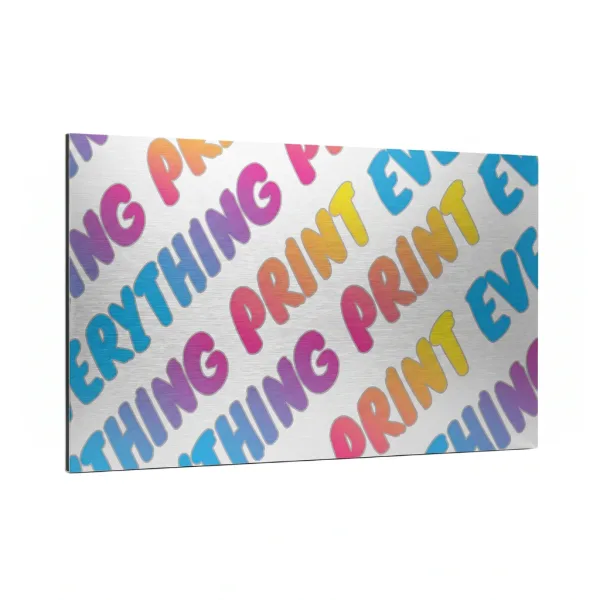
- Material: two aluminium skins on a polyethylene core, UV printed direct
- Sizes: A7 up to A0, 600 × 400 mm, 800 × 400 mm and fully custom CNC-routed shapes
- Where: outdoors and indoors, long term
- Finishing: CNC-routed edges, cut-outs and drilled holes for standoff fixings
We flatbed print Dibond direct to the substrate with UV inks, then CNC route it for smooth edges, cut-outs and drilled holes for standoff or mechanical fixings. Where a building's face needs a clean, modern panel rather than the heavier look of steel, Dibond is the board.
Chromadek vs Dibond: how to choose
Both are serious outdoor materials, so the choice usually comes down to budget, the look and the mounting:
- Choose Chromadek when you want the familiar coated-steel sign at a lower cost, a heavier presence, or a welded steel frame for a large freestanding site or development board.
- Choose Dibond when you want the premium option: a lighter, dead-flat panel with clean CNC-routed edges, cut-outs or standoff fixings, and an architectural finish for plaques and shopfronts.
If you are torn, send us a photo of the site with your quote request and we will recommend one.
Correx boards: temporary and high-volume outdoor signage
Correx is fluted polypropylene: light, water-resistant and the most economical board we print. It is the board estate agents, event organisers and contractors reach for because it goes up quickly and costs little, even in volume.
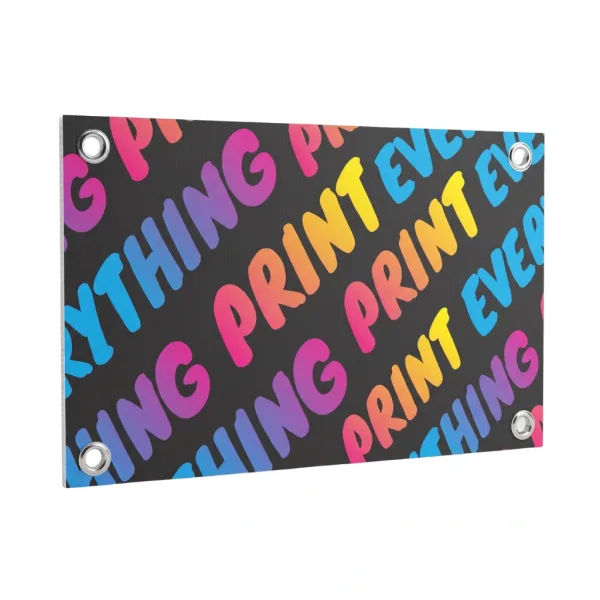
- Material: fluted polypropylene in 3 mm or 5 mm, UV printed direct
- Sizes: A7 up to A0, the standard 600 × 400 mm estate board and custom cuts
- Where: outdoors for campaigns and site work; indoors too
- Finishing: heavy-duty metal corner eyelets for cable-tie mounting on request
We print Correx in 3 mm, the economical choice for show-house boards, event signage and high-volume campaigns, and 5 mm for the extra rigidity a construction site or a longer outdoor campaign needs. Artwork is UV printed directly onto the board, so the colour is on the substrate rather than on a vinyl that can lift. Correx is excellent for campaigns and directional signage; it is not a substitute for Chromadek or Dibond where you need permanent branding on a building.
Correx vs ABS for outdoor work
Correx wins on weight, cost and volume: when you need fifty boards for a launch weekend, Correx is the answer. ABS costs more, and wins when the sign must survive knocks and abrasion, on factory floors, in plant rooms and on compliance boards, or when you want a solid, smooth plastic face rather than a fluted one. Many sites use both: Correx on the perimeter, ABS on the safety wall.
ABS plastic signs: built to take a knock
ABS (acrylonitrile butadiene styrene) is a high-impact thermoplastic. It flexes instead of shattering, which is why it turns up on factory walls, in warehouses and on rugged commercial installations. Our ABS signs are UV printed directly onto the satin-matte white face for a scratch-resistant finish that stands up to weather and cleaning agents.
- Material: high-impact ABS in 0.9, 1.5 or 3 mm, UV printed direct
- Sizes: A7 up to A0, 600 × 400 mm, 800 × 400 mm and custom cuts
- Where: indoors and outdoors; safety, factory and industrial signs
- Fixing: drill, screw, rivet or glue straight onto walls, machinery or fencing
Thickness matters with ABS, so we offer three:
- 0.9 mm: flexible utility for industrial product tags, thin display strips and signs that follow a gentle curve.
- 1.5 mm: the everyday benchmark for workplace safety boards, compliance signage and retail panels.
- 3 mm: maximum thickness for structural panels in demanding outdoor or high-wear environments.
Foam board: smooth indoor displays
When the brief is a retail counter, an exhibition wall or a corporate interior, you want a smooth, matte face without fluting. Our foam boards are compressed, rigid PVC foam (the material often sold as Forex), which gives a perfectly flat, ridge-free surface that UV prints with gallery-clean clarity, at a cost only a little above Correx.
- Material: rigid PVC foam in 3 mm or 5 mm, UV printed direct
- Sizes: A7 up to A0, 600 × 400 mm, 800 × 400 mm and custom cuts
- Where: indoors only
- Fixing: drilled for hanging systems or mounted with double-sided tape
We supply 3 mm for lightweight point-of-sale and exhibition panels and 5 mm where you need more rigidity for hanging graphics or longer indoor installations. One rule: keep foam board indoors. Sun, wind and rain belong to Correx, ABS, Dibond and Chromadek.
Need depth or gloss? Consider Perspex
If the sign needs depth, a gloss finish or a cut-out shape, Perspex (acrylic) signs are the sixth board in the family, CNC cut and UV printed the same way. For indoor point-of-sale builds such as spinning wheels and shelf units we use Xanita, a light recycled fibreboard: read our Xanita board guide. Ask us when you quote.
How we print sign boards in Cape Town
All five materials are produced under one roof at our factory in Atlas Gardens, Cape Farms, Cape Town, and are not sent out to a subcontractor for the print.
That is not a blanket same-day promise for every metal or framed sign. If you need it faster, say so when you order and we will tell you what is possible.
For artwork, supply a vector PDF at the finished size (or at a stated scale for very large signs), keep logos and text clear of the edges and any fixing holes, and make sure photographs are high resolution at the printed size. Artwork and turnaround questions are answered in our Help Centre, and you can read more about the process on our large format digital printing and CNC routing pages, or browse the full signage and large format range.
We also quote for professional installation of signage and large-format branding, and agencies and print brokers can produce through our Reseller Partner Programme.
Frequently asked questions
What is the difference between Chromadek and Dibond?
Chromadek is pre-coated steel: heavier, familiar, the more economical of the two, and available flat or on a welded frame. Dibond is aluminium composite: lighter, very flat, with clean CNC-routed edges and a premium finish at a premium price. Both suit long-term outdoor use; budget, the look you want and how the sign will be mounted decide between them.
Which signage material is best for outdoor use in Cape Town?
For permanent outdoor branding, start with Chromadek or Dibond. For temporary campaigns, estate boards and high-volume promotions, use Correx. Choose ABS when impact resistance matters, such as safety and industrial signs. In every case, match the thickness and the fixing method to the wind on your site, and check whether a roadside or building sign needs approval from the City of Cape Town.
Which sign board is the cheapest, and which is the most expensive?
Correx is the most economical board we print, followed by foam board, then ABS. A flat Chromadek sheet sits mid-range, with a welded frame adding to it. Dibond is the premium board and the most expensive per square metre.
Is Correx waterproof?
Correx is water-resistant fluted polypropylene and is used outdoors across South Africa for temporary signage. Choose 5 mm where you need more rigidity, and add corner eyelets or a frame in windy positions. It is not meant to replace a permanent metal or composite sign on a building.
Can foam board be used outside?
We recommend foam board for indoor retail, exhibition and corporate displays only. For anything exposed to the weather, choose Correx, ABS, Dibond or Chromadek.
Correx or ABS: which should I choose?
Pick Correx for light, cost-effective outdoor campaigns at volume. Pick ABS when the sign must survive impacts, factory wear or compliance use, and choose 0.9 mm, 1.5 mm or 3 mm to match the job.
Do you print directly onto Chromadek and Dibond?
Yes. Chromadek, Dibond, Correx, ABS and foam board are all UV printed direct to the substrate on our flatbed presses, so the colour bonds to the board face rather than relying on a separate vinyl layer.
How long does a Chromadek sign take to make?
A Chromadek sign typically takes five to seven days from an approved brief and artwork; a very large or framed sign may take longer and may carry a delivery charge. Correx and most rigid plastics are usually quicker. Your quote states the timeline, and rush production is quoted case by case.
Should I choose 3 mm or 5 mm Correx?
Use 3 mm for economical, high-volume estate and event boards. Use 5 mm when you want a more rigid board for a construction site, a windy fence line or a longer campaign.
Which ABS thickness should I use for factory safety signs?
1.5 mm is the everyday benchmark for workplace safety and warehouse boards. Step up to 3 mm for structural or high-wear outdoor panels, and use 0.9 mm for flexible tags and thin strips.
Can you install signs in Cape Town?
Yes. We quote for the installation of signage and large-format branding alongside the print. Mention installation on the quote form or see our installations page.
Ready to choose your board?
Send us the size, whether the sign goes indoors or outdoors, how long it must last and your artwork or a rough sketch. We will recommend Chromadek, Dibond, Correx, ABS or foam board, print it in our Cape Town factory and, if you need it, quote for installation.
Request a quote